Overview
This Python script is designed to backtest a trading strategy based on the Bollinger Bands, Relative Strength Index and Exponential Moving Average technical indicators. It connects to the Interactive Brokers (IB) API to fetch historical data, computes the technical indicators, executes the trading strategy and evaluates its performance using key financial metrics.
Main Script
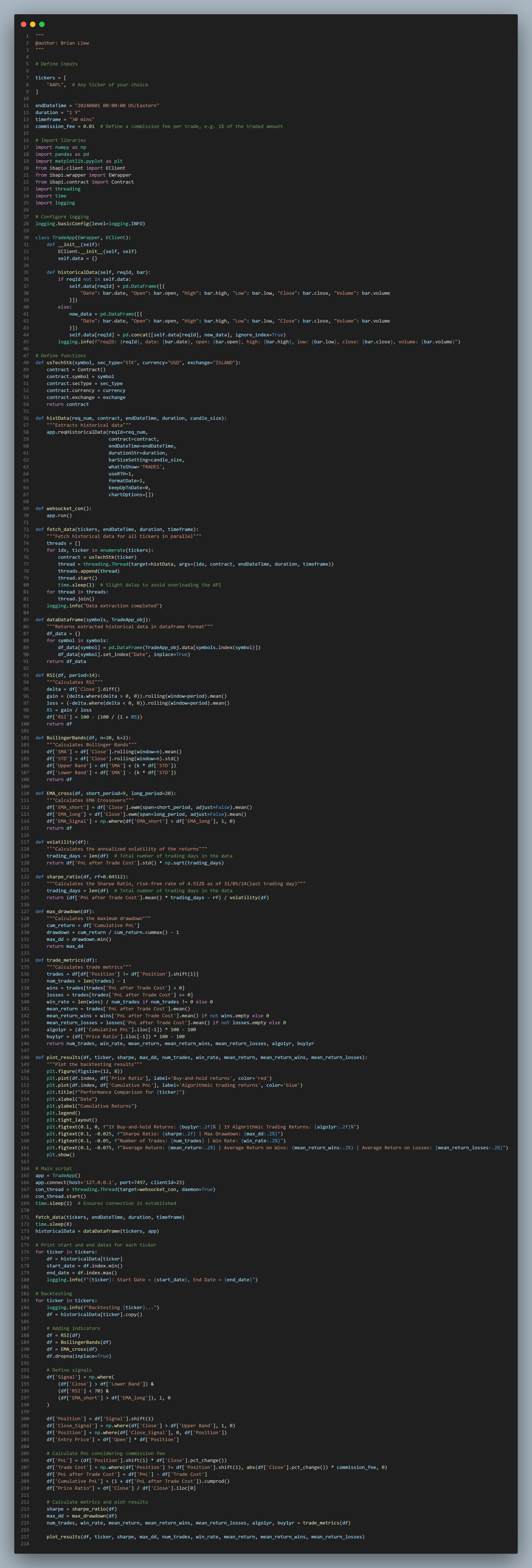
1. Initialization
The initialization section defines the necessary inputs and imports the required libraries. It also sets up logging and defines the TradeApp class to handle data retrieval.
- Inputs: The tickers (e.g.,
AAPL), end date for data retrieval, duration of historical data, timeframe for each data point, and commission fee per trade. - Libraries: The script imports necessary libraries such as
numpy,pandas,matplotlib, andibapifor API interactions with Interactive Brokers. - Logging: Configures logging to track the progress and any issues during execution.
- TradeApp Class: Inherits from
EWrapperandEClientto manage API interactions and store the historical data.
2. Data Retrieval
The data retrieval part of the code defines functions to fetch historical stock data.
- usTechStk: A helper function to create a contract object for the given ticker.
- histData: Requests historical data for a given contract and time period.
- websocket_con: Starts the websocket connection to Interactive Brokers.
- fetch_data: Fetches historical data for all specified tickers in parallel using threads.
- dataDataframe: Converts the raw data into pandas DataFrames for easier manipulation and analysis.
3. Backtesting
The backtesting section involves calculating technical indicators, generating trading signals, and evaluating the performance of the trading strategy.
- Technical Indicators: Functions to calculate RSI, Bollinger Bands, and EMA crossovers.
- Trade Signals: Generates buy/sell signals based on the technical indicators.
- Position and PnL Calculation: Determines the trading position and calculates the profit and loss (PnL) while accounting for commission fees.
- Metrics Calculation: Calculates key metrics such as Sharpe Ratio, maximum drawdown, number of trades, win rate, average returns, and compares the performance of the algorithmic trading strategy with a buy-and-hold strategy.
4. Visualisation
The visualisation part plots the results of the backtesting, showing the performance of the trading strategy compared to a buy-and-hold strategy.
- plot_results: Creates a plot comparing the cumulative returns of the buy-and-hold strategy and the algorithmic trading strategy. It also annotates the plot with key metrics such as Sharpe Ratio, maximum drawdown, number of trades, win rate, and average returns.
Sample Charts for AAPL, DIS and WMT


Performance of the strategy varies depending on the stock. For example, this strategy worked excellently with Disney, achieving a strong Sharpe ratio of 1.51 and a 1 year return of 33.33%, beating the buy-and-hold strategy significantly. However, the same algorithm performed poorly when paired with Walmart, losing to the buy-and-hold strategy by more than 10%.
Final Thoughts
The code presented offers a comprehensive framework for algorithmic trading strategy backtesting. Below are some final thoughts, key considerations, future research directions, and concluding remarks:
Key Considerations
- Algorithm Robustness:
- Stress-test this algorithm against different market conditions to evaluate its robustness. This includes periods of high volatility, low liquidity, and various economic cycles.
- Ensure the algorithm performs well across different timeframes and asset classes.
- Commission and Slippage:
- Consider transaction costs and slippage more rigorously. The current model uses a flat commission rate, but real-world costs can vary based on volume, market conditions, and broker policies.
- Implement slippage models to account for the difference between expected and actual trade prices.
- Risk Management:
- Implement risk management techniques such as stop-loss orders, position sizing, and portfolio diversification to manage and mitigate risks.
- Regularly review and adjust risk parameters based on changing market conditions and personal risk tolerance.
Future Research Directions
- Strategy Optimization:
- Explore optimization techniques such as genetic algorithms or machine learning to fine-tune strategy parameters for better performance.
- Backtest with more sophisticated strategies, including machine learning-based predictive models, statistical arbitrage, and high-frequency trading.
- Advanced Indicators:
- Integrate more advanced technical indicators and features, such as machine learning-based signals, sentiment analysis, and macroeconomic indicators.
- Conduct feature engineering to create new, potentially more informative indicators.
- Multi-Asset Strategies:
- Expand the backtesting framework to handle multi-asset strategies, including equities, bonds, commodities, forex and crypto.
- Implement portfolio optimization techniques to achieve better diversification and risk-adjusted returns.
- Live Trading and Automation:
- Transition from backtesting to live trading with a robust and secure execution framework.
- Implement real-time data feeds, automated order execution, and monitoring systems to handle live market conditions.
- Performance Attribution:
- Develop tools to attribute performance to different factors such as market conditions, strategy signals, and execution quality.
- Use performance attribution to continuously refine and improve the trading strategy.
Conclusion
This algorithmic trading framework provides a solid foundation for backtesting and evaluating trading strategies. It incorporates essential elements such as data extraction, technical indicator computation, signal generation, and performance metrics. By considering key factors such as data quality, algorithm robustness, transaction costs, risk management, and regulatory compliance, traders can develop more effective and reliable strategies.
Future research directions include optimization, advanced indicators, multi-asset strategies, live trading automation, and performance attribution. These advancements can help traders stay competitive in an ever-evolving market environment.
Feel free to use the codes shared for your own tickers!
 The Intrinsic Investor